
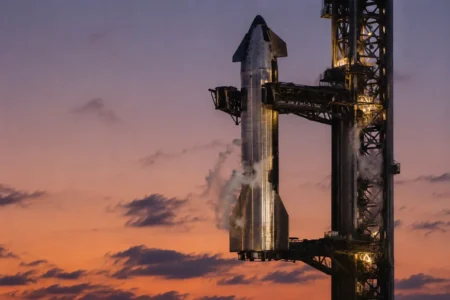
SpaceX has just accomplished something that could change how rockets return from space. On November 14, 2026, the company successfully caught the upper stage of its Starship rocket after a journey around Earth, bringing the spacecraft back to its launch tower in Texas instead of allowing it to land in the ocean.
The achievement represents a major step toward fully reusable spacecraft, but it does not mean SpaceX has solved every challenge. The mission combined a historic landing with a significant setback, making it one of the most revealing Starship tests so far.
What Happened During SpaceX’s Latest Starship Flight?
SpaceX launched its 15th Starship test flight from Starbase, Texas, on November 13, 2026. The mission aimed to demonstrate something unprecedented: recovering both stages of the enormous rocket at the launch site. The Super Heavy booster powered the vehicle during its initial ascent, while the upper stage, known as Ship 42, continued into orbit. Over approximately 22.5 hours, the spacecraft completed 14 orbits around Earth and deployed 26 next-generation Starlink V3 satellites. On November 14, Ship 42 returned through Earth’s atmosphere and approached the same launch complex where its journey began. According to Space.com’s detailed mission coverage, the upper stage successfully entered the launch tower’s mechanical arms at approximately 4:20 p.m. Eastern Time.
How Did SpaceX Catch a Rocket Returning From Orbit?
Unlike conventional spacecraft that rely on parachutes or ocean splashdowns, Starship uses rocket engines to control its final descent. After traveling around Earth, Ship 42 reentered the atmosphere and endured extreme heating as it slowed down. Near the ground, the spacecraft reignited its engines, rotated into a vertical position, and carefully approached the launch tower. Two enormous mechanical arms, often nicknamed chopsticks, secured the vehicle before its engines shut down. The process demanded precise coordination between the spacecraft’s propulsion, guidance systems, and ground infrastructure. This was not simply another successful landing. SpaceX demonstrated that an orbital spacecraft could return directly to a launch facility and be captured by equipment designed to support future recovery and reuse.
Why Is This Such a Big Deal for Space Travel?
Rocket reusability has already transformed the launch industry, particularly through SpaceX’s Falcon 9 program. However, recovering a booster is different from recovering an upper stage that has traveled at orbital speeds. The upper stage must survive much more demanding atmospheric reentry conditions before performing a controlled landing. Successfully catching Ship 42 brings SpaceX closer to recovering the entire Starship system rather than discarding major components after each mission. In theory, reusable spacecraft could reduce hardware replacement costs and support more frequent launches. The important distinction is that recovery alone does not guarantee economical reuse. Engineers must still inspect the vehicle, evaluate heat-shield damage, service its engines, and demonstrate that it can fly again reliably.
Did Everything Go According to Plan?
Not quite. SpaceX originally intended to catch both the Super Heavy booster and the Starship upper stage during Flight 15. Although the booster successfully helped launch Ship 42, its planned return to the tower was aborted. Instead, it diverted toward the Gulf of Mexico, where it was lost. The mission therefore fell short of demonstrating complete recovery of both stages. As reported by Reuters, the successful upper-stage catch nevertheless marked an important breakthrough in SpaceX’s effort to develop a fully reusable launch system. This mixed outcome illustrates how experimental rocket development works: one major objective can succeed while another reveals problems that engineers must investigate before the next flight.
What Makes Starship Different From Other Rockets?
Starship is designed as a two-stage transportation system consisting of the Super Heavy booster and the Starship spacecraft. Together, they stand approximately 124 meters, or 407 feet, tall, making the vehicle the largest and most powerful rocket system ever flown. Its stainless-steel construction, methane-fueled Raptor engines, and ambitious recovery architecture distinguish it from conventional expendable launch vehicles. SpaceX ultimately wants both stages to return for inspection, refurbishment, and repeated flights. The company’s long-term plans include transporting large payloads into Earth orbit and supporting missions beyond Earth. However, Starship remains an experimental system, and its impressive size does not automatically translate into operational reliability or lower launch costs.
Could This Breakthrough Make Space Travel Cheaper?
Potentially, but the economics depend on much more than catching a spacecraft. Traditional rockets often discard expensive hardware after a single mission. Recovering that hardware creates an opportunity to spread manufacturing costs across multiple launches. Yet reuse only becomes financially attractive when refurbishment expenses, turnaround times, and maintenance requirements remain manageable. A spacecraft that needs extensive repairs after every flight may offer fewer savings than expected. SpaceX must also demonstrate consistent performance across repeated missions, not just individual successful tests. The November achievement establishes an important technical capability, but the company has not yet demonstrated routine reuse of the recovered Starship upper stage.
What Happens Next for SpaceX and Starship?
The next major challenge is turning a successful recovery into a repeatable process. Engineers will need to examine Ship 42, evaluate its condition after atmospheric reentry, and determine which systems require servicing or replacement. SpaceX must also investigate why the Super Heavy booster could not complete its planned catch. Future tests will likely focus on improving recovery reliability and demonstrating that both stages can return safely during the same mission. These capabilities matter for SpaceX’s broader ambitions, including NASA’s lunar exploration program and potential missions to Mars. Reaching those destinations will require additional advances in orbital refueling, spacecraft operations, and long-duration mission systems. The latest flight represents progress toward those goals, not their completion.
Final Thoughts
SpaceX’s November 14 achievement is significant because it demonstrated the controlled return and tower capture of a spacecraft after orbital flight. The successful recovery of Ship 42 brings the company closer to its vision of rockets that can fly repeatedly instead of being discarded after each launch. At the same time, the loss of the Super Heavy booster shows that major engineering challenges remain. The real test now is whether SpaceX can repeat this success, recover both stages consistently, and turn experimental technology into a practical transportation system.
FAQ
Did SpaceX successfully land Starship in November 2026?
Yes. On November 14, SpaceX successfully recovered the Starship upper stage, Ship 42, using the mechanical arms of its launch tower in Texas. The spacecraft returned after approximately 22.5 hours in orbit. However, the Super Heavy booster was not recovered during the same mission.
Has SpaceX created a fully reusable rocket?
Not yet in routine operation. SpaceX has demonstrated recovery of Super Heavy boosters on earlier flights and successfully caught an orbital Starship upper stage in November 2026. It still needs to recover both stages reliably and demonstrate that recovered vehicles can be refurbished and flown again.
Why does SpaceX catch rockets with mechanical arms?
The tower’s mechanical arms allow SpaceX to capture returning vehicles without relying on traditional landing legs. The approach could eventually support faster processing and reuse, although its practical advantages depend on reliable operations and manageable refurbishment requirements.
Will this Starship breakthrough help NASA reach the Moon?
It could. NASA plans to use a specialized Starship lunar lander for its Artemis program. Reliable spacecraft operations and reusability are relevant to SpaceX’s broader development efforts, but lunar missions also require capabilities such as orbital propellant transfer, landing systems, and extensive testing.
Picture Credit: AI